
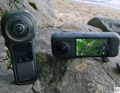
Top 4 360 Cameras Compared
Other Options
Insta360 X3 for $250: With 5.7K footage on a 1/2-inch sensor, it’s 1080p when cropped to a rectangular video format. At this price, the X3 offers an affordable option for those exploring 360 video, also usable as a 4K, single-lens action cam.
Insta360 One RS for $300: This interchangeable-lens hybrid is another choice. Despite not matching the video quality of others, the ability to swap lenses and quickly transition to an action camera is a notable feature. Although the X3 and X4 now offer similar functionalities, the One RS remains appealing for users preferring the action-camera style with 360 capabilities. The ideal setup combines the 360 lens with the Leica lens, though at a higher cost.
GoPro Max for $822: As GoPro’s entry into 360 cameras, the Max offers 6K video with advanced stabilization in a waterproof design. Familiar shooting modes like HyperSmooth and TimeWarp are included. The Hero mode is a single-lens feature, compatible with most GoPro mounts and accessories. However, with the anticipated release of the Max 2, it’s recommended to wait for the new model.
Qoocam 3 Ultra for $599: Though not widely available and untested by us, the Qoocam 3 Ultra shows promise with an 8K resolution and a notable f/1.6 aperture. We will provide an update after testing.
360 Cameras to Avoid
Insta360 One X2 for $230: Now outdated, the X2 is less convenient and functional compared to the X3. It offers 5.7K video but lacks the stabilization and sharpness of newer models. It’s not recommended unless priced under $200.
Insta360 One RS 1 360 Edition: Although personally appreciated, it’s discontinued with no successor. The X5 surpasses it in video quality and durability. Used units are overpriced, making the X5 a better alternative.
Frequently Asked Questions
Why Buy a 360 Camera?
360-degree cameras enable virtual reality content creation or capturing everything around you for later editing, delivering regular, rectangular video. Though not as high-quality as DSLRs, 360 cameras capture moments without needing specific focus.
Why Is High Resolution Important in 360 Cameras?
High resolution in 360 cameras ensures quality when cropping for traditional video formats. A higher resolution provides better results after reframing.
How Does “Reframing” Work?
Reframing involves focusing on a portion of the 360-degree footage to create standard video formats. For VR, reframing isn’t necessary.
How We Tested
Testing involved shooting in diverse conditions, assessing camera usability, features, and editing tools. Ensuring seamless integration with other cameras and evaluating the software for editing were key components.