
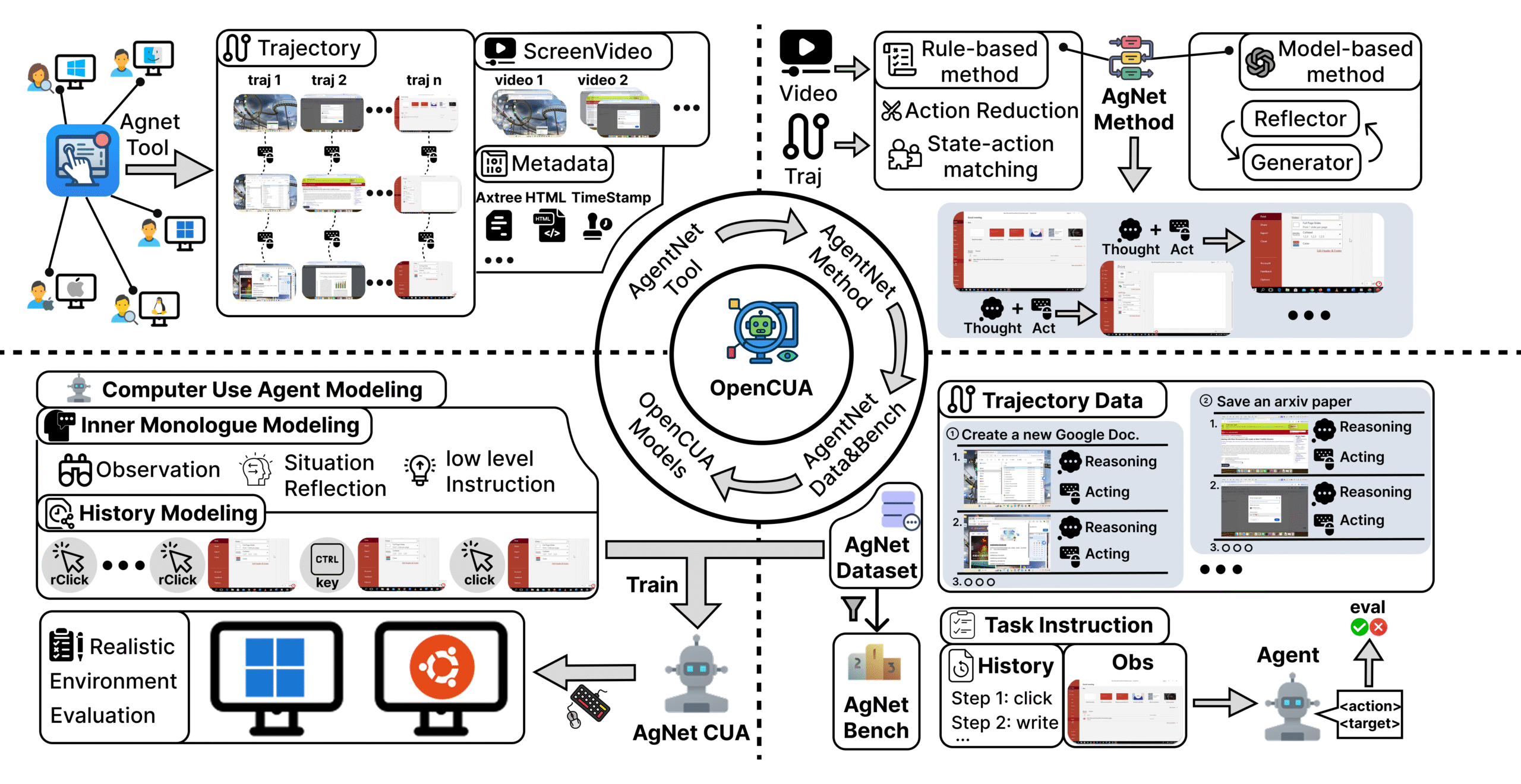
Researchers at The University of Hong Kong (HKU) and collaborators have developed OpenCUA, an open-source framework to create robust AI agents for computer operation. OpenCUA includes tools, data, and guidelines for developing computer-use agents (CUAs) that perform well on benchmarks, outperforming existing open-source models and rivaling top proprietary agents from companies like OpenAI and Anthropic. These agents autonomously complete computer tasks, from navigating websites to using complex software, assisting in enterprise workflow automation. However, the details of top-performing systems are often proprietary, limiting transparency and raising safety concerns.
The researchers stress the need for open CUA frameworks to study AI capabilities and ensure safety, as outlined in their paper. Open source efforts hindered by limited data collection infrastructure and insufficient dataset transparency have been addressed with OpenCUA. The framework scales data collection with the AgentNet Tool, capturing human task demonstrations on various systems. The gathered data, ensuring privacy, discusses over 22,600 task demonstrations across multiple OS applications and websites.
OpenCUA introduces a new pipeline for training agents, enhancing raw data with chain-of-thought reasoning to improve models’ understanding of tasks. This process includes planning, memory, and reflection organized into three levels. The framework enables companies to train agents on proprietary tools without manual data configuration.
OpenCUA was tested with various vision-language models, achieving state-of-the-art results on benchmarks and narrowing performance gaps with leading proprietary models. The framework promises broad applicability, enhancing model performance across different tasks and environments, especially in enterprise workflows. Key challenges for live deployment include ensuring safety and reliability to prevent unintended system effects.
The code, dataset, and model weights are available for public use, potentially transforming how knowledge workers interact with computers by allowing AI agents to manage operational tasks while humans focus on strategic objectives. OpenCUA envisions AI agents working alongside humans like colleagues, where the agents handle the “how” as humans define the “what.”