
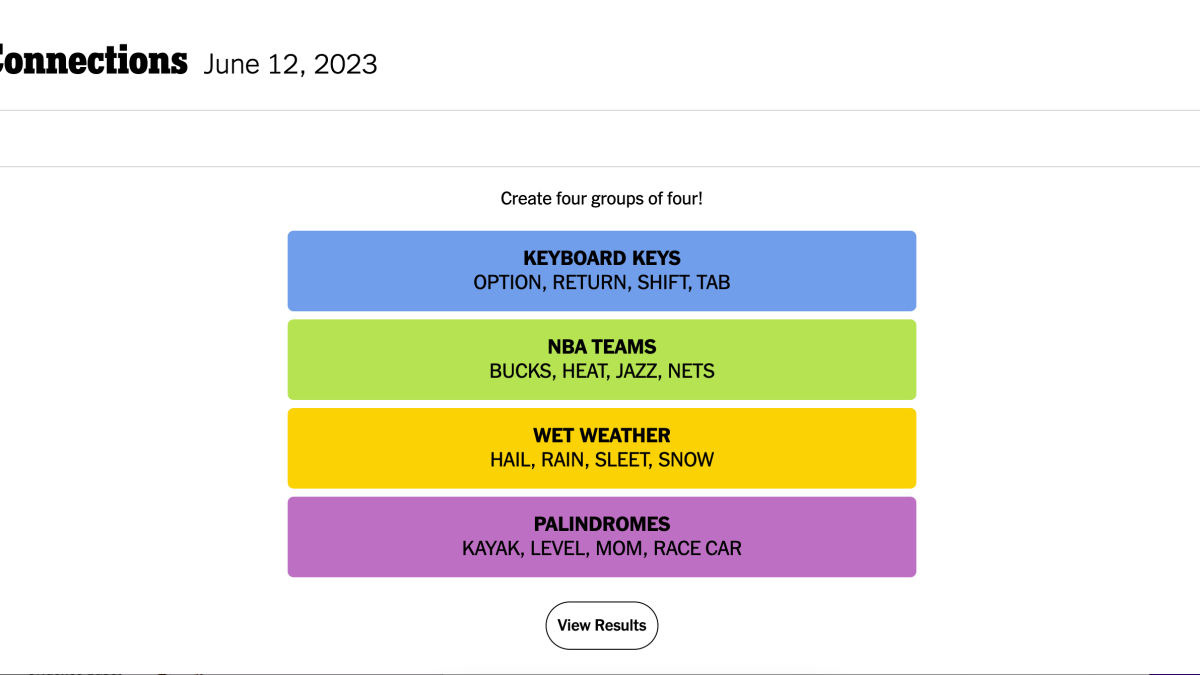

The NYT’s Connections is a game that challenges your brain. You might think “these words belong together,” and then realize “oh, wait.” Your task is to divide 16 words or phrases into four groups of four, but the groupings can be tricky. I’ll explain the game and how you’ll need to think to play it well.
I have an explainer here on the difference between Wordle, Strands, and Connections—all NYT word games, each with a different gameplay style and rewarding different skills. Connections is ideal if you like wordplay and general knowledge references. However, be ready for tricks, as this game often uses words’ double meanings in crafty ways. And if you get stuck, you can check out our daily hints.
Where to play Connections
Connections is a New York Times game, available on the paper’s Games page and in their Games app. A new, numbered puzzle is available every day, similar to daily Wordles.
How to play Connections
The game gives you 16 tiles, each with a word or short phrase. Your goal on each move is to select four tiles that form a group. Groups are usually similar (like HAIL, RAIN, SLEET, SNOW) but there’s often a grouping involving wordplay. For example, one puzzle grouped DOUBT, SHADOW, MOVIE, and VOTE—those are all things you can cast.
If you’re wrong, the tiles shake. If you’re close, a “one away” message indicates you had three correct. If you’re right, a colored bar appears near the top of the board (showing the four words and revealing their theme), and remaining tiles rearrange at the board’s bottom.
You have four mistakes available. Once you run out, the game ends, and you’ll see the missed answers.
Despite having four groups, you only need to solve three. At the end, four tiles remain that must form a group. For extra fun, try to determine the theme before submitting that last group for your gimme point.
Why Connections can be so frustrating (and how to avoid dumb mistakes)
The game is designed to be tricky. Puzzle designers may include a group of five or more words fitting the same category, but only four form a legal group. They might also group four items that could belong together, assigning each to a different category based on double meanings.
As an example, in my first game attempt, I submitted an obvious group: RAIN, HEAT, SNOW, and SLEET. Not valid, the game told me. Huh?
Moments later, the “Huh?” became an “Aha!” as HEAT matched with JAZZ, BUCKS, and NETS to form NBA teams. Elsewhere, HAIL didn’t mean gesture or greeting but fit with the wet-weather words. RACE CAR, seemingly an outlier—no other vehicles—was part of a set of palindromes.
How to win at Connections
As I learned on my first play, the point is not to look for just any