
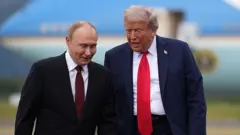
The Kremlin has minimized speculation about an upcoming summit between Russian President Vladimir Putin and Ukraine’s Volodymyr Zelensky, following Donald Trump’s call for the two leaders to meet to discuss ending the war in Ukraine. This push comes after the US president met with Putin in Alaska last week and welcomed seven European leaders and Zelensky to the White House on Monday. Trump acknowledged the difficulty of resolving the conflict and conceded that the Russian president might not be interested in ending hostilities. “We’re going to find out about President Putin in the next couple of weeks,” he said on Tuesday. “It’s possible that he doesn’t want to make a deal.”
If Putin is indeed uninterested, Trump indicated that the Russian president faces a “rough situation,” without providing further details. On Monday, Putin told Trump he was “open” to the idea of direct talks with Ukraine, but the following day, Foreign Minister Sergei Lavrov diluted that commitment. Lavrov stated that any meeting would need careful preparation, starting at the expert level and progressing through necessary steps, echoing a common Kremlin stance. Dmitry Polyanskiy, a Russian deputy representative to the UN, told the BBC that “nobody [had] rejected” the idea of direct talks, though it should not be a meeting “for the sake of a meeting.”
Reports on Tuesday indicated that Putin had suggested Zelensky travel to Moscow for talks, a suggestion unlikely to be accepted by Ukraine. The proposal might be Russia’s way of offering an option that Kyiv could not possibly agree to. Recent talks seem to have given Trump a renewed understanding of the complexities of the war and the gap between Moscow’s demands and Kyiv’s position. The ceasefire Trump claimed he could secure from Putin has not materialized, and now he suggests Ukraine and Russia move directly to a permanent peace deal. Some progress was made regarding security guarantees for Ukraine.
Zelensky and European leaders have appeared to convince Trump that such commitments are crucial for Kyiv’s sovereignty in a peace agreement. On Tuesday, Trump said the US is willing to support European efforts “by air” if European countries provide ground forces in Ukraine under a ceasefire or peace deal, though he ruled out sending US troops. However, Trump did not specify whether this air support would involve intelligence or the use of fighter jets and warplanes. Although Trump’s commitments remain vague, the France and UK-led Coalition of the Willing is working on a plan for a reassurance force that could be deployed to Ukraine if hostilities end. After a virtual meeting of the group on Tuesday, a Downing Street spokesperson stated that the group would meet US counterparts soon to “further strengthen plans to deliver robust security guarantees.”
After his summit with Putin and discussions with Zelensky, Trump seems to believe that direct talks between Ukraine and Russia could bring a peace deal closer, though he acknowledged “tremendous bad blood” between the two leaders. The last meeting between them was in 2019. Since then, Moscow’s war on Kyiv has caused tens of thousands of casualties and widespread destruction, with ongoing attacks on civilian targets. Putin deems Zelensky illegitimate and blames him for Ukraine’s growing ties with the West. For years, Putin has made baseless claims about Kyiv being ruled by a “neo-Nazi regime” and insisted that any ceasefire must involve a change in Kyiv’s leadership. Russia is also uninterested in talks while its forces hold an advantage on the front line.
Nonetheless, European leaders and Zelensky favor the idea of a bilateral meeting. The Ukrainian president stated on Monday that he was open to “any format” of meeting with Putin, while the Europeans have proposed potential summit locations. By supporting direct talks, they hope to persuade Trump to adopt a firmer stance against Moscow if Putin remains uncooperative in ending the war.
Meanwhile, Ukraine’s European allies are less optimistic than Trump about reaching a conflict resolution. On Tuesday, French President Emmanuel Macron called Putin “a predator, and an ogre at our doorstep” and expressed doubt about Putin’s willingness to work towards peace. Finnish President Alexander Stubb remarked that Putin is “rarely to be trusted” and was skeptical about a meeting with Zelensky occurring. More high-level talks are planned as questions linger over Trump’s support for Europe. Britain’s military chief, Admiral Tony Radakin, is heading to Washington for discussions on deploying a reassurance force in Ukraine, while NATO military chiefs will hold a virtual meeting on Wednesday.