
Google researchers have created a new AI research framework that surpasses systems from OpenAI, Perplexity, and others on key benchmarks. The agent, named Test-Time Diffusion Deep Researcher (TTD-DR), draws inspiration from human writing processes involving drafting, information seeking, and revisions. It uses diffusion mechanisms and evolutionary algorithms for detailed and accurate research on complex topics. This approach could generate valuable enterprise research assistants for tasks like competitive analysis or market entry reports, which challenge retrieval augmented generation systems.
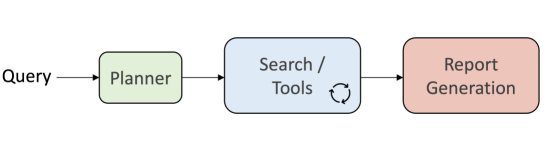
Current deep research agents struggle with complex queries due to their reliance on large language models and tools like web search, often using test-time scaling techniques for synthesis. Most existing agents lack the structure of human cognitive behavior, using rigid linear or parallel processes that hinder interactive and corrective research phases. Such limitations cause loss of global context and critical information connections, stressing the need for a cohesive framework that mirrors human research capabilities.
TTD-DR adopts an iterative approach akin to human researchers, starting with a high-level plan, initial draft, and multiple revision cycles enhanced by new information searches. Inspired by diffusion models used in image generation, Google’s framework refines a “noisy” initial draft into a polished report, aided by retrieval components. The system’s core, “Denoising with Retrieval,” iteratively improves drafts by incorporating external details to correct and elaborate reports.
“Self-Evolution” allows agent components like the planner, question generator, and answer synthesizer to autonomously enhance their efficiency, akin to an evolutionary process. This approach leads to logically coherent and accurate reports, evaluated on criteria like fluency and coherence. TTD-DR can handle diverse industry domains, producing helpful reports for complex queries similar to deep research initiatives from OpenAI, Perplexity, and Grok.
For building and testing, TTD-DR used Google’s Agent Development Kit (ADK) with Gemini 2.5 Pro as the core LLM, yet is adaptable for other models. It was tested against systems like OpenAI Deep Research and Perplexity Deep Research, focusing on long-form report generation using the DeepConsult benchmark and long-form research datasets. It outperformed competitors, with higher win rates and better multi-hop reasoning benchmarks.
The framework, while text-focused, is designed for adaptability, evident in potential expansions to tasks like complex code generation, financial modeling, or multi-stage marketing campaigns through iterative refinement. Such a draft-centric approach could underpin various complex AI agents for enhanced multi-step capabilities.