
European leaders expressed cautious optimism following a virtual meeting with Donald Trump on Wednesday, ahead of his upcoming meeting with Russian counterpart Vladimir Putin in Alaska to discuss ending the war in Ukraine.
Trump reportedly informed the Europeans that his objective for the summit was to secure a ceasefire between Moscow and Kyiv. He also agreed that any territorial issues must involve Volodymyr Zelensky and that security guarantees should be part of the agreement, according to France’s Emmanuel Macron.
Speaking with Trump allowed Macron to “clarify his intentions” and gave the Europeans a chance to “express our expectations,” he said.
Trump and Vice-President JD Vance spoke with leaders of the UK, France, Germany, Italy, Finland, and Poland, as well as EU chief Ursula von der Leyen and NATO chief Mark Rutte.
The Europeans have been excluded from the hastily organized summit in Alaska and their call today was a last-ditch effort to keep Ukraine’s interests and the continent’s security on Trump’s agenda.
It appeared to be somewhat effective. On Wednesday evening, Trump rated the meeting “a ten” and said Russia would face “very severe” consequences unless it stopped its war in Ukraine. He also mentioned that if Friday’s meeting was successful, he would try to arrange a “quick second one” involving both Putin and Zelensky.
Nevertheless, in their statements, European leaders emphasized the need for Kyiv to be involved in any final decision, underlying their concern that Putin might persuade Trump to concede Ukrainian land for a ceasefire.
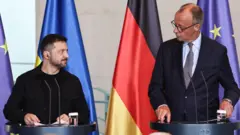
“It’s most important that Europe convinces Donald Trump that one can’t trust Russia,” said Poland’s Donald Tusk, while German Chancellor Friedrich Merz stressed the necessity for Ukraine to be “at the table as soon as follow-up meetings occur.”
If Russia refused concessions, “then the United States and we Europeans should and must increase the pressure,” Merz stated.
Since the US-Russia summit’s announcement, Trump has mentioned “land-swapping” between Kyiv and Moscow, alarming Ukraine and others that he might concede to Putin’s demands for Ukrainian territory.
Russia’s Foreign Ministry spokesperson Alexey Fadeev reiterated their unchanged stance since Putin’s demand in June 2024 for a ceasefire if Ukraine withdrew from four regions partially occupied by Russia—Donetsk, Luhansk, Kherson, and Zaporizhzhia—and ceased efforts to join NATO.
These demands are seen as unfeasible by Kyiv and European partners. Zelensky warned that any region allowed to remain with Russia could be a launchpad for future invasions. Security guarantees, meant to ensure Ukraine’s defense, could counter this threat.
After the call with Trump, European leaders indicated that security guarantees were discussed and UK Prime Minister Keir Starmer noted “real progress” on this front. He commended Trump’s efforts, saying, “For years this conflict has persisted without a viable solution. Now, we have a chance due to the president’s efforts.”
Since the spring, the UK and France have led efforts to form a “Coalition of the Willing,” nations committed to deterring further Russian invasion of Ukraine. The coalition offered to play an “active role,” including deploying a “reassurance force” once hostilities ceased, though specifics remain unclear.
Meanwhile, Russia’s summer offensive continues. Zelensky pointed to Moscow’s troop advances near Dobropillya in Donetsk, asserting that Putin is pretending sanctions aren’t harming Russia’s economy. “I told Trump and our European allies that Putin is bluffing,” he said, urging them to exert “more pressure” on Russia.
Trump admitted that he might not be able to persuade Putin to stop civilian attacks, acknowledging, “I’ve had that conversation with him… but then I see reports of rockets hitting civilian areas, and people lying dead. So probably not.”