
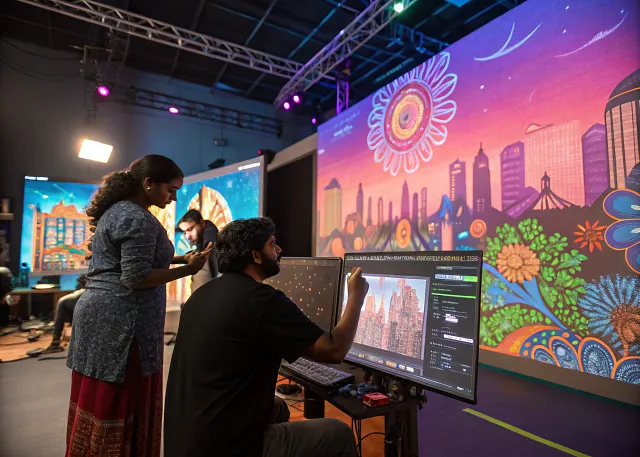
In 2025, artificial intelligence (AI) is transforming creative industries—film, music, art, literature, and design—altering content creation, production, and consumption. India’s creative economy, valued at ₹2.2 trillion and growing by 20% annually, is a hub for AI innovation, with AI-generated Bollywood scripts and virtual influencers in advertising. However, this shift brings ethical questions about authorship, cultural integrity, and economic equity. As AI reshapes creativity, this analysis examines the ethical challenges, societal impacts, and strategies for responsible integration within India’s vibrant creative landscape.
**Ethical Dilemmas in AI-Driven Creativity**
AI’s role in creative industries balances innovation and ethical responsibility. Authorship and Intellectual Property issues arise, as AI tools generate content from human-created works without clear consent. This raises ownership questions: who owns an AI-generated song based on Bollywood classics? India’s Copyright Act, 1957, lacks provisions for AI-generated content, risking artist exploitation. Globally, lawsuits like those against Stability AI in 2024 demand fair compensation.
Bias and Cultural Representation are challenges. AI models trained on Western-centric datasets can misrepresent Indian nuances, creating clichéd outputs, like art focused on peacocks or the Taj Mahal, omitting regional aesthetics. This risks cultural erasure, especially for marginalized communities.
Job Displacement is significant. AI automates tasks like video editing, threatening 15 million jobs in India’s creative sector. A 2025 NASSCOM report predicts 30% of jobs, including illustrators, face automation risks by 2030. However, AI also creates roles like prompt engineering, requiring reskilling.
Authenticity and Human Connection are threatened. AI-generated content, such as virtual influencers, can mislead audiences, eroding trust. In India, AI-crafted films risk losing emotional impact if overly reliant on algorithms instead of human storytelling.
**Societal Impacts**
AI in creative industries has transformative yet uneven consequences. Economically, it democratizes creativity, enabling small studios to compete with industry giants. AI tools costing ₹500–2,000 monthly boost India’s creative exports, projected to reach $60 billion by 2030. However, wealth concentration in tech firms risks marginalizing traditional artists, with 70% of creative AI revenue going to global platforms like Adobe.
Culturally, AI can preserve heritage, like AI-driven restoration of Raj Kapoor’s 1960s Bollywood films. Yet, overreliance on AI risks commodifying culture, reducing art to algorithm-optimized mass content, seen in AI-curated playlists on JioSaavn prioritizing viral hits over indie talent.
Socially, AI enhances access but deepens divides. Rural creators with limited internet struggle to access AI tools, widening urban-rural gaps. Ethical lapses, like AI-generated misinformation, erode trust, with 65% of consumers wary of deepfakes (2025 Deloitte survey).
**Recent Developments and Challenges**
India’s 2025 creative AI landscape is dynamic but contentious. The IndiaAI Mission’s ₹2,000 crore Creative AI Fund supports startups like Kalaari-backed ArtVerse, which develops AI tools for regional languages. AI-generated films like “Zero,” premiering at the 2025 Mumbai Film Festival, spark debates over “soulless” art. Challenges include regulatory gaps, data privacy concerns, and skill transitions, with only 20% of creative professionals trained in AI (2025 FICCI report).
**Strategies for Ethical Integration**
A multi-pronged approach is essential:
– **Policy Frameworks:** Accelerate the Digital India Act for transparent AI training data and fair artist royalties. A national AI ethics board with diverse creative input is needed.
– **Transparency and Consent:** Platforms should disclose AI use in content creation, requiring artist consent for data use, tracked through blockchain-based registries.
– **Upskilling:** Train 1 million creatives in AI tools by 2030, focusing on Tier-2/3 cities, with government and industry collaboration.
– **Equitable Access:** Subsidize AI tools for rural creators, similar to PM Suryaghar’s solar model.
– **Cultural Safeguards:** Develop India-specific AI models like BharatGPT, using diverse datasets to reflect regional art forms.
**Tips for Stakeholders**
– **Creatives:** Use AI as a collaborator but maintain human oversight for authenticity.
– **Businesses:** Partner with ethical AI startups for transparent data practices and ESG compliance.
– **Consumers:** Support platforms emphasizing artist credits and advocate for ethical AI.
– **Policymakers:** Promote AI literacy and enforce penalties for unethical data use, aligning with global standards.
**Conclusion**
AI in India’s creative industries is driving innovation and economic potential. However, without ethical guidelines, it risks cultural dilution, job loss, and inequity. By promoting transparency, inclusivity, and governance, India can harness AI to enrich its creative heritage while establishing