
Last Friday, Donald Trump and Vladimir Putin held a summit in Alaska, filled with ceremony but lacking major diplomatic advancements towards ending the Russia-Ukraine conflict.
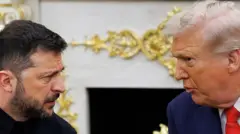
On Monday, six European leaders hurried to Washington DC to discuss the outcomes of the Putin meeting with Trump. Despite the meeting’s historic nature at the White House, it was more about speeches than achieving concrete progress.
With limited successes from both summits, Trump, who campaigned on ending foreign wars, faces growing pressure. Yet, there were two potentially meaningful developments.
During the White House meeting on Monday, Trump seemed willing to consider US security guarantees for Ukraine if a deal is reached, which is deemed crucial by Ukrainians and their European allies for a lasting peace.
On Tuesday morning, Trump clarified that US involvement might include “air support” instead of sending American troops to Ukraine, with Europe expected to bear most of the responsibility.
He also announced plans for a potential bilateral summit between Putin and Zelensky, contingent on finalizing details, and afterward, he would join them for a three-way meeting.
European leaders are pushing for a ceasefire before any bilateral talks, a move Trump thinks is unlikely.
Nevertheless, initiating leader-level negotiations between Zelensky and Putin is significant progress.
Yesterday’s meetings between Trump, Zelensky, and European leaders took place in a pleasant, cooperative manner, notable given Zelensky’s contentious visit to the White House in February and Trump’s sometimes tense relations with European leaders.
Trump relished being a welcoming host in Alaska and at the White House, and he seems to see resolving the Ukraine conflict as pivotal to his legacy.
“If I can get to heaven, this will be one of the reasons,” he remarked in a Tuesday television interview.
However, the path to heaven is narrow, as the saying goes, and numerous challenges remain in ending the Ukraine war, not least because it’s uncertain if Putin, making slow battlefield progress, desires an end to the conflict.
The Russian leader may believe his position strengthens over time and aim to delay negotiations while avoiding new US sanctions that could further harm its economy.
Trump, who halted those sanctions, seems convinced that Putin is open to a deal.
In a private conversation with French President Emmanuel Macron, caught on a live microphone, Trump expressed this belief.
“I think he wants to make a deal for me, you understand that?” Trump said. “As crazy as it sounds.”
This view might seem naïve, given Putin’s ongoing aggression in Ukraine for nearly four years. But the American president appears to trust in Putin’s supposed goodwill.
Even assuming Putin is a genuine negotiating partner—a big “if”—Trump could prove unpredictable. Though the White House meetings went well, he’s known for abrupt policy shifts and might change his stance again, as he has done regarding Zelensky in the past eight months.
Building peace on American guarantees may not offer a stable foundation. The efforts by European leaders to flatter Trump on Monday hinted at their concerns about his sometimes volatile temperament.
“In the past two weeks, we’ve likely made more progress in ending this war than in the past three and a half years,” Finnish President Alexander Stubb observed.
European leaders’ quick trip to Washington aimed to influence Trump’s perception, limiting Putin’s sway over him.
Alongside key players, another factor influencing Trump is his political base, which embraces his “America first,” non-interventionist rhetoric.
Any military commitments or new foreign obligations Trump considers for peace could face skepticism from his supporters.
They were uneasy about the US strikes on Iran in June, and ongoing obligations to Ukraine might challenge Trump’s preference for focusing inward—a situation he might want to sidestep.
Despite progress, the core truth remains: Trump aspires to be seen as a peacemaker. However, compared to Europe, Russia, or Ukraine, he has the least at stake in these talks.
Ultimately, Trump could choose to withdraw. The option to walk away is a form of power.