
The 10% Rule: How Much to Invest in Customer Success? Insights from Notion’s CRO and GitHub’s VP of CS
Every B2B CEO grapples with this question. At SaaStr Annual + AI Summit, experts from Notion and GitHub offered their insights.
Key Speakers:
Erica Anderson – CRO, Notion
Erica, guiding Notion’s revenue strategy, has a decade of experience at GitHub. Her innovative approach focuses on sustainable growth via customer obsession, aiming for a 3.9% ARR on customer experience, below the industry standard of 10%.
Abbas Haider Ali – VP of Customer Success, GitHub
Abbas has reshaped customer engagement in tech companies, emphasizing robust CS frameworks for satisfaction and growth. His detailed operational document, scrutinized monthly, has been pivotal in this transformation.
Fun fact: Their professional interaction began uniquely—Erica announced her departure from GitHub to Abbas on his first day, setting a collaborative tone in tech leadership.
Insights from SaaStr Annual’s Chief Customer Officer Summit discussion with these leaders highlight strategies from scaling CS organizations through multiple growth phases.
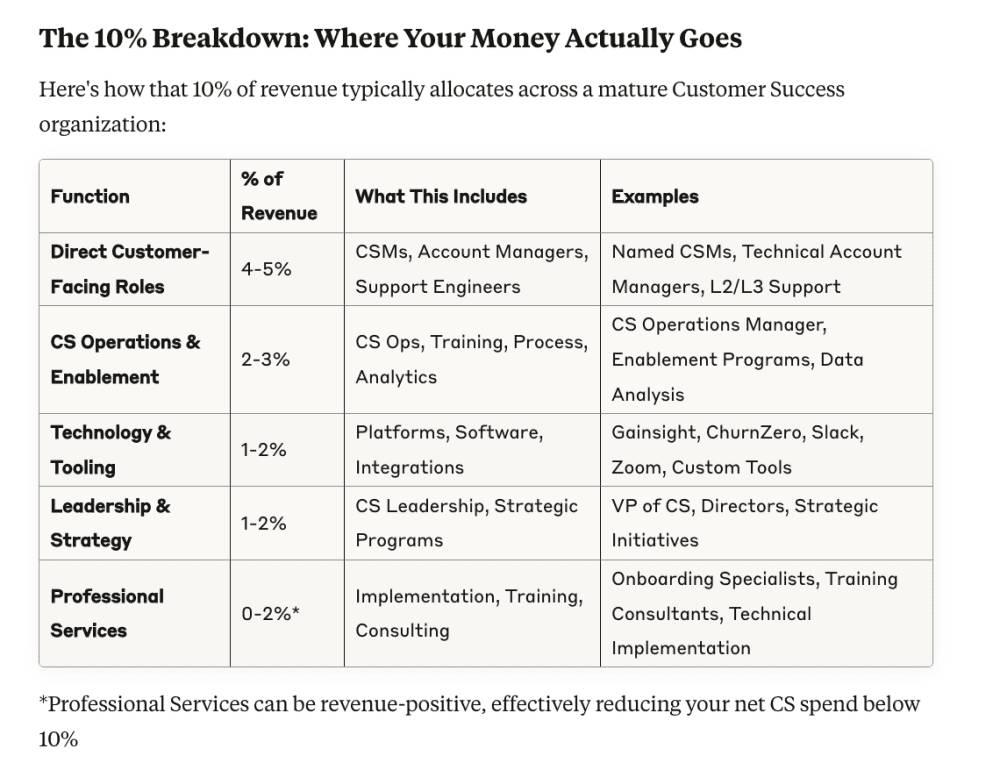
Key Takeaway: Allocate 10% of your revenue to post-sales activities. If exceeding this, ensure a compelling justification.
SaaS leaders frequently ask about the right investment in Customer Success. Balancing growth with profitability is crucial, and insights point to investing 10% of revenue in post-sales activities.

The Rationale for 10%
The 10% figure is derived from understanding the economics required to maintain scalable, sustainable SaaS growth by:
- Adhering to Rule of 40
- Facilitating effective subsequent funding rounds
- Scaling towards public listing
- Achieving predictable, profitable growth
Successful SaaS companies allocate about 10% for post-sales, maintaining this consistently.
Evaluating CS Investment
There are two main perspectives to assess Customer Success investment:
1. Numerical Evaluation
The 10% rule can be expressed as:
- Percentage of ARR
- Absolute dollar allocation
- Cost per customer
- Investment per cohort
Professional Services is included here, needing clear distinction between CS investment and revenue centers.
2. Functional Investment Model
This concerns deployment across the customer journey in three areas:
Dedicated Hands-On Support: High-touch CS managers and account managers focused on relationships.
Pooled Resources: Shared services for multiple customer segments, including CS operations and technical resources.
Digital-First Experiences: Self-service tools, in-app guidance