
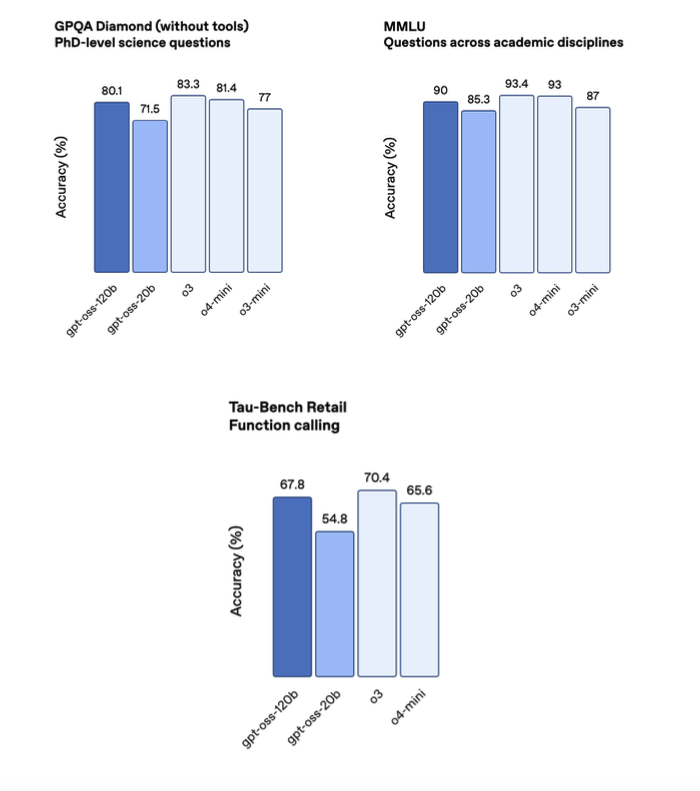
OpenAI is returning to its open-source AI beginnings with the announcement and release of two new open-source frontier large language models (LLMs): gpt-oss-120b and gpt-oss-20b. The former is a 120-billion parameter model, suitable for running on a single Nvidia H100 GPU, while the latter, at 20 billion parameters, can run on a consumer laptop or desktop PC. Both are text-only models, differing from the multimodal AI that allows for file and image uploads. However, they can still write code and solve math problems, and they surpass some of OpenAI’s paid models globally.
The models are free for enterprises and developers to download and modify, offering maximum privacy as they can be run locally. Available today with full weights on Hugging Face and GitHub, gpt-oss-120b matches or exceeds proprietary models on benchmarks in various areas, while gpt-oss-20b outperforms others in some benchmarks. Both models perform well in multiple languages.
A significant feature is the Apache 2.0 licensing, which offers more flexibility than other open-source licenses. OpenAI’s gpt-oss models have no usage restrictions, allowing customization for revenue generation without any costs. This allows enterprises to use a powerful AI model locally, maintaining privacy.
The release comes more than six years after OpenAI’s last open-source language model. OpenAI’s decision to offer these open-source models despite their booming paid services reflects competition from other open-source models. OpenAI aims to provide a full range of AI solutions, from proprietary to open-source, even if the latter doesn’t bring direct revenue.
Training and architecture of gpt-oss models were influenced by developer feedback, employing a Mixture-of-Experts architecture with a Transformer backbone. OpenAI emphasizes safety measures, including adversarial fine-tuning and external evaluations, ensuring they remain below high capability thresholds for risk domains. The models are available on major platforms with deployment support from partners like Microsoft and NVIDIA.
With open-source AI models growing in competitiveness, OpenAI aims to invite users into its ecosystem, despite expectations of increased competition in the AI market. The release of the gpt-oss series strengthens OpenAI’s position, catering to enterprises and privacy-conscious users. The broader implications of offering open-source models in a competitive market remain to be seen.